- 2025 -
Establishment of our organization as a non-profit
Our founder focused on building the infrastructure needed to establish BEI as a standalone non-profit, which later made us eligible to receive funding from the Foundation for Black Communities. Our first General Circle (board) meeting was held in February 2025. Soon after, we recruited a former Roots for Resilience volunteer as Program Assistant and welcomed a videography artist as Visual Documenter, following a model emulating the civil rights groups of the 1970s, where grassroots activism was powerfully illustrated by daily and weekly artistic documentation.
2nd Year of Roots for Resilience
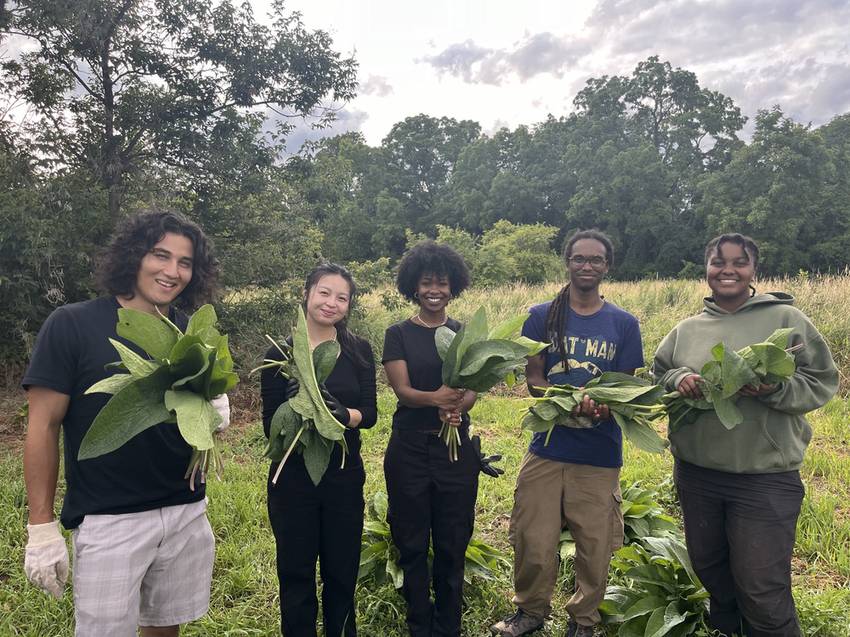
In the summer of 2025, we launched the second edition of the Roots for Resilience Initiative. With the support of a grant from the Foundation for Black Communities, BEI was able to bring back the urban agriculture program at Maloca Community Garden.
This year also marked an important step in strengthening our team. We welcomed Mahalia as Program Assistant and Abdu as Visual Documenter, while continuing with Muzamil as the lead staff anchor for the program.
This initiative was thoroughly documented by our visual documenter, Abdu, and all recordings of the Roots for Resilience sessions are available on the BEI Instagram page: https://www.instagram.com/blackenvironmentalinitiative/
The full report for the second year will be published here soon.
In the meantime, you can watch a short documentary about this program on our YouTube channel
Screenings in the Garden
In 2025, thanks to the initiative of Abdu, we hosted our first film screenings at the garden, featuring two educational documentaries. This pilot activity has the potential to grow into a powerful way of engaging youth in meaningful conversations about complex social and environmental issues.
Food Security Community Event
Also in 2025, thanks to the initiative of Mahalia, our Program Assistant, we organized our first community event bringing together youth and elders to discuss food security in Black communities. This intergenerational dialogue opened space for learning, sharing experiences, and building connections across generations.
Key Conferences and Training Sessions
In 2025, our founder offered a two hour training session on environmental racism to 800 government officials of the Ontario Ministry of Children, Community and Social Services. He also joined a panel on food and environmental justice at the 11th Annual Environmental and Health Disparities Symposium.
- 2024 -
1st year of Roots for Resilience
In 2024, through the initiative of Muzamil, we launched the first year of the Roots for Resilience Urban Agriculture program at Maloca Community Garden.
The program successfully engaged over 80 youth in nature-based activities, fostering both environmental awareness and a sense of community.
You can find a report on Year 1 here.
City of Toronto Community Consultations
In 2024, we partnered with the City of Toronto to host community consultation sessions, gathering feedback from Black Torontonians to help shape the City’s Parks and Recreation Facilities Strategy. The report is available here.
Adventure Canada Partnership
In 2024, we partnered with Adventure Canada to launch an initiative that sent six Black environmentalists on a two-week journey to the Arctic. Fully funded by BEI, this experience was created to open access to spaces where Black professionals are often excluded, challenge stereotypes, and encourage greater diversity and inclusion within exclusive environmental fields. As part of this partnership, Adventure Canada also received an anti-racism training session facilitated by Naolo, Muzamil, and Cheyenne Sundance, who was part of our team at the time.
Afro-holistic education with ACHA
In 2024, we partnered with the African Canadian Heritage Association to deliver Afro-inspired environmental education workshops, bringing culturally rooted learning to their communities.
Watch the video on these sessions
Collaboration with McGill University and Stanford University
Our founder was invited to contribute to an essay collection on Climate Justice & Technology, a collaboration between McGill University and Stanford University. His piece explored how climate and environmental justice movements provide models of resistance against the “technology of cultural monoculture,” offering alternative pathways rooted in equity, resilience, and community.
 31st Regular Session of the CEC Council: Strengthening Environmental Justice through Community Empowerment.
In 2024, our founder was invited by the Commission for Environmental Cooperation to participate in an environmental justice event in North Carolina, where he contributed as a featured speaker.
Transition out of the Makeway Shared Platform and out of CCECJ
In 2024, after carefully assessing BEI’s challenges, opportunities, and available human resources, our founder initiated a transition out of the MakeWay platform to focus fully on building BEI as an independent organization. That same year, Bill C-226—Canada’s first national environmental justice law—was successfully passed in June, marking a historic milestone. With this momentum, our founder also stepped down from leadership at CCECJ to dedicate their full attention to advancing BEI’s vision. This transition was successful, enabling us to retain our staff, strengthen our organizational foundation, and continue moving our mission forward.
- 2023 -
Participation in an Environmental Justice gathering, Mexico
Our Founder was invited to participate to an environmental justice gathering in Mexico in the Oaxaca area. The workshop involved a small group of EJ leaders from communities and organizations in Canada, Mexico and the United States recommended by the CEJN Steering Committee (based on their practical experience carrying out innovative environmental justice and climate resilience projects in their communities).
Partnership with CMOS and CRWA
In 2023, BEI has worked with CMOS and the Canadian Water Resources Association (CWRA) to understand some of the barriers keeping underrepresented youth (especially Black and Indigenous) from considering career options and studying weather, water, and climate science.
The research was done thanks to the support of Environment Canada.
Report available here
BEI Produced Documentary: Stand like a tree
Contribution to a book on environmental justice
Our founder contributed a chapter in French to the book La Nature de l’Injustice, adding a vital perspective on environmental and social justice to this important collective work.
La nature de l’injustice | Écosociété
- 2022 -
- 2021 -
Raising Awareness in the Media and in the Social and Environmental Sectors
Highlights from 2020 to 2021 include a strong presence in the media to raise awareness about environmental justice issues. We also participated in a lot of conferences and webinars to raise awareness about environmental racism and the lack of diversity, equity and inclusion in the environmental sector.
List of public outreach outputs.
Training and Giving Opportunities to the Next Generation of Environmental Justice Leaders
In the second year, we focused on recruiting additional youth volunteers, providing them with numerous chances to showcase their talents and launch their own initiatives.
Furthermore, BE Initiative received a donation from Nature Canada, which we promptly transferred to CCECJ. With these funds, we initiated a new internship program within the coalition, known as the Youth Environmental Justice Leads program.
We selected three youth from the black community and afforded them the invaluable opportunity to attend COP 26 in Scotland. Here, we provided them with training in environmental communications and offered ongoing mentorship. Following this, we placed them in two partner organizations: Climate Action Network and the Coalition for Black Trade Unionists. At COP 26, we facilitated connections with some of our American partners, including the esteemed Dr. Bullard, widely recognized as the father of environmental justice.
Upon their return from COP 26, we further honed the interns’ environmental communication skills by linking them with media opportunities. As a result, they established their own platforms and garnered attention from the media.
All three interns achieved remarkable success, securing extensions of their internships with the hosting organizations. Some were even offered full-time positions. They also attained notable professional milestones, including acceptance into fellowship programs at Ryerson University and other esteemed programs in Washington DC.
Finally, two of our inaugural cohort of interns launched their own environmental justice initiative.
While this program was implemented under the CCECJ brand, BE Initiative initiated, designed and coordinated most of the program in collaboration with our partners.
- 2020 -
The Canadian Coalition for Environmental and Climate Justice (CCECJ)
Highlights from our first year of operation include the launch of a collaborative project with the ENRICH project of Dr. Ingrid Waldron.
We started together a coalition that was initially called the National Anti-Environmental Racism Coalition, which was later rebranded to the Canadian Coalition for Environmental and Climate Justice (CCECJ), a coalition that is now a distinct organization.
CCECJ was created out of our common passion for environmental justice and our desire to energize the environmental justice movement in Canada.
In its first year, CCECJ was able to mobilize individuals, academics, community members and key environmental and social groups in Canada (like the David Suzuki Foundation, Environmental Defense and more) around a common agenda for the environmental protection of Indigenous and racialized communities.
One of CCECJ key outcome was a quite successful campaign including a petition that collected over 12,000 signatures for the passing of the first environmental justice bill in Canada.
4 years later, in 2024, the bill was successfully passed as the first environmental justice law in Canada.
You can learn more about CCECJ by visiting www.ccecj.ca